
Approximation is a method used in mathematics to find a value that is close to the exact number, but not necessarily the exact value itself. We use approximation when the exact value is not needed, when dealing with very long decimal numbers, or when we want to make calculations faster and easier.
How to Do Approximation
There are different ways to approximate numbers, depending on the level of accuracy needed:
Rounding Off to nearest _______
Rounding means adjusting a number to the nearest ten, hundred, whole number, or decimal place.
- To round off, look at the digit after the place value you are rounding to.
- If that digit is 5 or more, increase the previous digit by 1.
- If it is less than 5, keep the previous digit the same.
Example:
- 46 rounded to the nearest ten is 50.
- 3.746 rounded to two decimal places is 3.75.
Significant Figures
Significant figures (or sf) are used to show how precise a number is.
How to count number of significant figures
- The first non-zero digit is always the first significant figure.
- To round to a certain number of significant figures, count from the first non-zero digit.
Rounding off to ____ significant figures
To round off to ___ significant figures, you look at the digit after the place value of the significant figure you are rounding off to, if that digit is 5 or more, increase the previous digit by 1. If it is less than 5, keep the previous digit the same.
Example: Round 0.004075 to 2 significant figures.
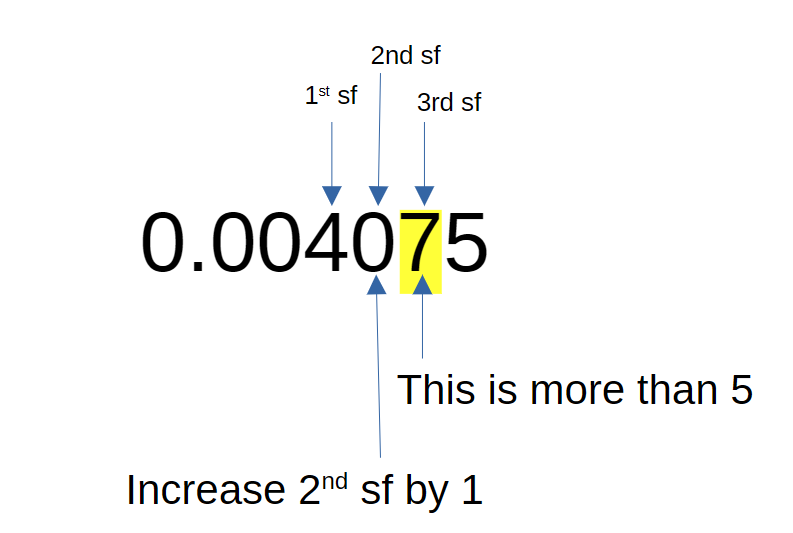
Hence, 0.004075 is 0.0041 when rounded off to 2 significant figures.
Other Examples of Rounding off to ____ Significant Figures
- 0.004522 rounded to 2 significant figures is 0.0045.
- 38,462 rounded to 3 significant figures is 38,500.
Rounding off and the Math Exams
Here’s what you’ll see at the cover page of the Math Papers in secondary schools:
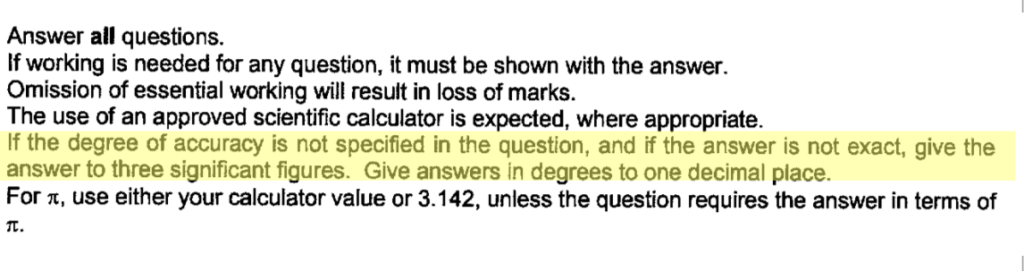
So, if the answers are not exact and it is not specified in the question, you have to round them off to 3 significant figures (3 s.f) for all, and 1 decimal place (1 d.p) for answers in degrees.